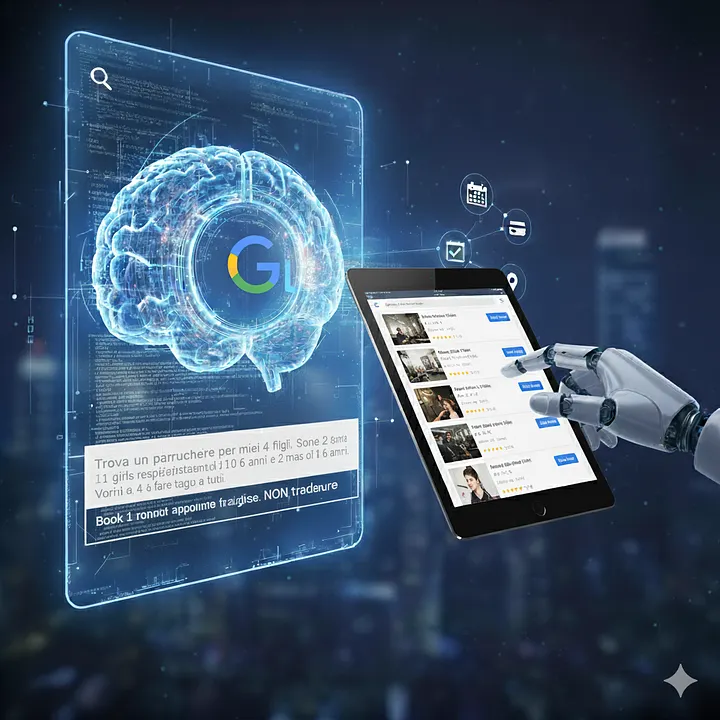
The End of Search, The Beginning of Action: Why Google Has Become an Agent
For decades, Google Search has been the gateway to digital knowledge, a Search Engine whose primary goal was simple: index the web and provide the most relevant list of links in response to a query. Its success was measured by its ability to help us find the right information, leaving users with the “heavy lifting” — clicking, comparing, navigating, and ultimately, acting.
Today, that era is coming to an end.
We are in the midst of a silent revolution: Google is rapidly evolving into a Search Agent. This isn’t just an additional feature, but a radical paradigm shift. This new system no longer simply lists results, but directly executes a complex task on behalf of the user.
The Agent receives an articulated prompt (no longer a simple keyword), reasons about it, interacts with external systems, and completes the requested action — whether that’s finding a specific restaurant with availability for eight people and dietary restrictions, or booking an appointment for a local service.
This transformation marks the definitive shift from information to action, redefining not only the future of search, but especially how every service provider must operate to remain relevant.
From Information to Action: AI’s Quantum Leap
Until yesterday, the success of an online business was measured by its visibility: good positioning in results, a click that brought users to your site. The work ended there, leaving customers with the task of navigating, comparing, and ultimately acting (booking, purchasing, contacting).
Today, the AI Agent flips this logic. User requests are no longer simple queries, but articulated prompts rich with context: “Find a hairdresser for my 4 children. There are 2 girls aged 10 and 6 respectively, and 2 boys aged 4 and 1. I would like to book an appointment to get haircuts for all of them.”
The Agent doesn’t respond with a list of links, but with a final and immediate solution. If hairdresser A has all the characteristics but is bookable in a single step, and hairdresser B requires ten clicks on the site, the Agent will direct the user toward A. The new objective is not the click, but task completion. (Currently Google’s new system doesn’t handle hairdressers, but I like to think that will be the next step)
The Real Engine of Change: APIs and MCPs
To execute a final action — whether booking a table, a spa appointment, a concert ticket, or a barber’s cut — the AI Agent needs to interact directly with the company’s internal systems.
This is where APIs (Application Programming Interfaces) and MCPs (Merchant Controlling Platforms) come into play.
These interfaces aren’t just technical tools for developers; they’ve become the universal language of the AI-based economy. They allow the Agent to:
- Verify real-time availability.
- Send structured data (name, time, number of participants) to the internal management system.
- Receive confirmation of the completed transaction.
If your service is a digital island, inaccessible to these interconnection systems, the Agent, while knowing about you, will never be able to propose you as a definitive solution.
The Risk of Being “Cut Out”
The stakes are high. AI won’t be limited to restaurants; it’s destined to expand into every local service sector: medical appointments, event tickets, maintenance, logistics.
For providers, exposing their own APIs (or using platforms that do it for them) is no longer an advanced feature, but a survival strategy:
- Stay Visible: Being listed serves no purpose if the Agent can’t act on behalf of the user.
- Increase Conversion: The Agent acts as a salesperson or concierge, reducing friction between the user and the point of purchase.
- Compete in a New Market: Services that integrate into the AI ecosystem will be preferred and included in the user’s automated workflow.
Being outside this mechanism means being “cut out” of the new demand engine, condemned to serve only a small segment of users willing to still perform all the steps manually.
It’s Time to Evolve
The message is clear: technological innovation doesn’t wait. The era of the Search Agent has inaugurated the era of instant action. Every service provider, large or small, must look at their own infrastructure and ask themselves:
Is my inventory ready for AI? Is my booking system accessible via API?
Adapting today, by investing in the structured exposure of one’s services, is the only way to transform a potential risk into an enormous growth opportunity and to ensure that one’s service continues to exist and prosper in the economy of the future.
Inspired by the video analysis by Raffaele Gaito: https://www.youtube.com/watch?v=b7NwFiR5-gQ