How AI is Transforming Code Documentation: Experiments, Impacts, and New Perspectives
In recent months, I’ve experimented with various artificial intelligence tools dedicated to automatic code documentation generation. This is a rapidly evolving area with much deeper implications than it might seem: it’s not just about “writing better comments,” but about redefining how we understand, design, and maintain software, especially in a world where more and more code is generated through approaches like vibe coding or AI-assisted coding.
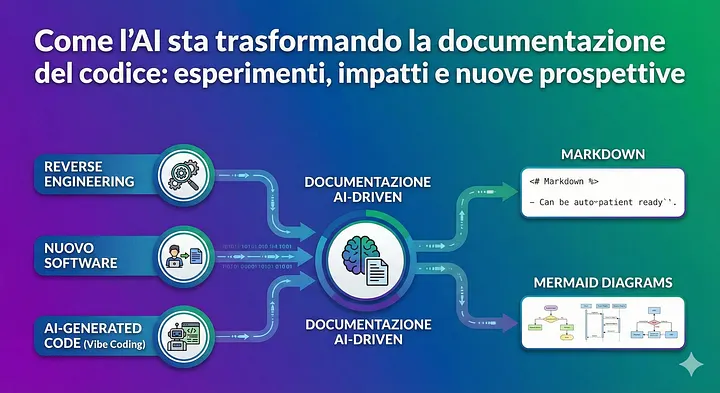
In this article, I share what I’ve observed: benefits, limitations, and new possibilities across three key areas:
- Reverse engineering of existing systems
- Documentation of new software
- Documentation of AI-generated code (vibe coding)
And I’m adding a crucial aspect: the combined use of Markdown and Mermaid, which, together with AI, is revolutionizing technical documentation.
1. AI Documentation and Reverse Engineering: Understanding Complex Software Becomes More Accessible
Many legacy systems lack adequate documentation, or the documentation is outdated. AI tools today enable us to:
- Summarize entire codebases in minutes
- Generate architectural overviews
- Identify flows, dependencies, and side effects
- Explain complex functions and modules
- Reveal implicit patterns or anti-patterns
The result? A dramatic reduction in the time needed to understand code written by others, especially when there’s no documentation or when it’s scattered, inconsistent, or excessively technical.
2. Documentation for New Software: From Tedium to Continuous Workflow
With AI, documentation is no longer a burdensome afterthought. It becomes a natural part of the workflow:
- Documentation automatically generated at commit time
- Comments and descriptions produced in real-time
- Diagrams automatically updated when dependencies change
- READMEs and API guides created directly from the codebase
Documentation thus becomes synchronized, consistent, and finally maintainable.
3. Regaining Control Over AI-Generated Code (Vibe Coding)
When using vibe coding (prompt → AI generation → iteration):
- a lot of code is produced quickly
- not everything is read or verified in detail
- architecture can emerge “unintentionally”
- dependencies grow implicitly
Here, AI-generated documentation becomes fundamental to regaining control:
- it clarifies what was generated and why
- it explains algorithms and architectural choices
- it highlights critical points or fragile parts
- it makes transparent what would otherwise remain a “black box”
It’s a modern paradox: AI documents code written by AI, but it works.
🧩 4. Markdown + AI: The Perfect Pair for Technical Documentation
Markdown is the perfect format for AI-driven documentation:
- readable in text form
- completely versionable
- compatible with GitHub, GitLab, Bitbucket, Medium, Notion
- ideal for READMEs, API guides, changelogs, technical SOPs
- extremely simple to generate automatically with AI
📄 Realistic example generated by AI from a real function:
### ⚙️ Function: processOrder(orderId)

**Description:**
Processes an order by retrieving data from the database, validating product availability, and updating the order status.

**Operational flow:**
1. Retrieve order data
2. Validate stock
3. Update DB
4. Notify user

**Dependencies:**
- `/services/inventory.js`
- `/services/notifications.js`
- `OrderRepository`
This type of documentation can be produced automatically by analyzing the codebase.
🎨 5. Mermaid: Automatic Diagrams from Code (and Therefore Versionable)
Mermaid allows you to generate complex diagrams using simple text. AI can read the code and automatically produce:
- flowcharts
- sequence diagrams
- module dependencies
- ERD (Entity-Relationship Diagrams)
- microservice architectures
- system workflows
This makes a type of visual reverse engineering possible that has never been so accessible.
🔁 Example: Flowchart generated from the processOrder function
flowchart TD
    A[Start] --> B[Retrieve order data]
    B --> C{Stock available?}
    C -- No --> D[Error: insufficient stock]
    C -- Yes --> E[Update database]
    E --> F[Send user notification]
    F --> G[End]
🧩 Example: module dependency map
graph LR
    UI[UI Layer] --> API[API Gateway]
    API --> SVC[Order Service]
    API --> INV[Inventory Service]
    SVC --> DB[(Order DB)]
    INV --> DB2[(Inventory DB)]
📡 Example: sequence diagram generated from code
sequenceDiagram
    User->>UI: Place Order
    UI->>API: POST /orders
    API->>OrderService: createOrder()
    OrderService->>InventoryService: checkStock()
    InventoryService-->>OrderService: OK
    OrderService->>DB: saveOrder()
    DB-->>OrderService: saved
    OrderService-->>API: orderId
    API-->>UI: 200 OK
🗄️ Example: ERD automatically generated from database schema
erDiagram
    ORDERS ||--o{ ORDER_ITEMS : contains
    PRODUCTS ||--o{ ORDER_ITEMS : referenced
    ORDERS {
        int id PK
        datetime createdAt
        string status
        int userId
    }
    PRODUCTS {
        int id PK
        string name
        float price
        int stock
    }
    ORDER_ITEMS {
        int id PK
        int orderId FK
        int productId FK
        int quantity
        float totalPrice
    }
🎯 6. Why This Combination is So Powerful
AI + Markdown + Mermaid enables:
- automatically generated and versionable documentation
- diagrams that are always up-to-date and reproducible
- visual flows consistent with the code
- immediate reverse engineering even on complex systems
- control over AI-generated code
In practice, we have for the first time an ecosystem of tools that:
- documents,
- visualizes,
- explains,
- versions,
- and evolves alongside the software.
Conclusion: Toward Human–AI Collaboration in Software Knowledge
Automatic documentation doesn’t replace human understanding: it amplifies it. The developer’s role is changing: from manual author of every line to curator of system knowledge.
We’re entering a new phase: documentation is becoming as intelligent as the software it describes.
And for the first time, we can document faster than we write code.